
-
-
-
Mechanics
Projectile Launcher
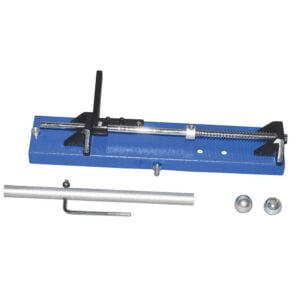
For exploring the projectile motion and trajectories. With a release latch that can be adjusted and locked in any desired setting, Supplied with two drilled balls, attached protractor and plumb bob for determination of angle of inclination. Includes a clamp to fasten the apparatus to a tabletop. With Instructions.
PH10412 -
Mechanics
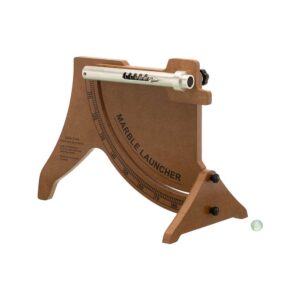
Marble Launcher
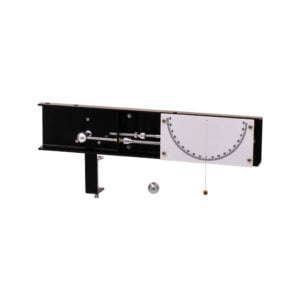
Durable apparatus to study velocity, acceleration, and projectile motion. Marbles can be launched from five different speeds at any angle between 0 and 90°.
Velocity of the marble can range from 3 m/s to 9 m/s. Easy-to-read protractor allows for precise measurements and calculations. Sturdy hardwood construction is built to last. Includes a detailed instruction guide and two marbles.
16″ L x 10″ W x 12½” H.
PH10414 -
Mechanics
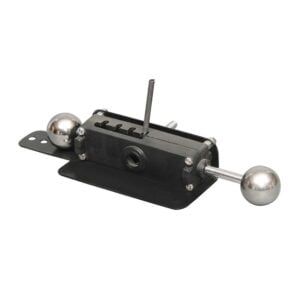
Second Law of Motion Apparatus
To demonstrate the Second Law of Motion simply and accurately, two identical balls-one drilled, and the other solid is used. When the release lever is triggered, the internal spring accelerates one ball and releases the other, showing that two balls dropped from the same height hit the ground at the same time even though one is traveling forward when the balls are released. Support stand and clamp required, but not included. With instructions.
PH10415 -
Mechanics
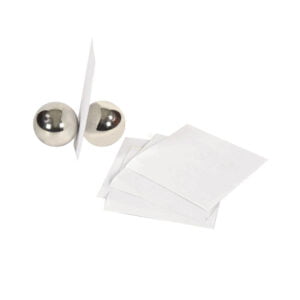
Energy Transformation Balls
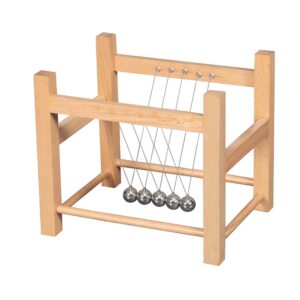
Demonstrates conversion of kinetic energy into heat and sound energy during a collision. Consists of a pair of heavy steel balls. When the balls strike against each other with a piece of paper between the balls, the heat causes a hole to appear in the paper. The kinetic energy of the balls upon collision is converted to heat which is sufficient to burn a hole in the paper. With instructions.
PH10416 -
Mechanics
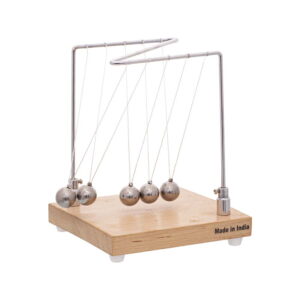
Pendulum Waves
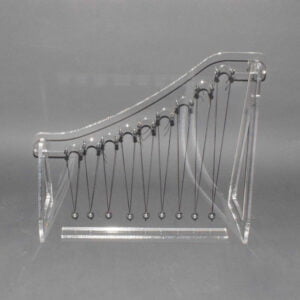
In this apparatus, you will use the laws of simple pendulum motion to create a pendulum wave apparatus: a device where many pendulums of different lengths, and therefore different periods, start swinging at the same time. As they move in and out of sync, the pendulums create a sequence of cycling visual wave patterns.
PH10420 -
Mechanics
Ballistic Pendulum Apparatus
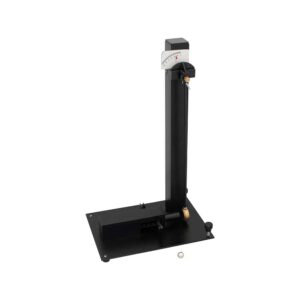
This apparatus is designed to clearly illustrate the principles of momentum conservation and the behavior of projectiles. It features a robust and stable base, complemented by a precision-mounted vertical pendulum. The pendulum is equipped with a specially designed pocket that securely holds a ball in a rubber ring, ensuring it remains in place upon impact. The setup allows accurate measurement of the pendulum’s deflection angle, enabling precise calculations of momentum transfer and trajectory. Constructed for durability and ease of use, the apparatus comes complete with a comprehensive instruction manual for guided experimentation.
PH10422 -
Mechanics
Supertek Monkey & Hunter Demonstration
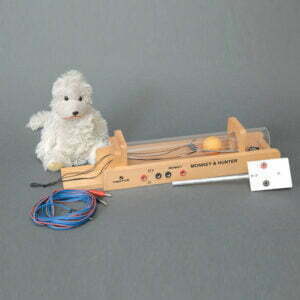
This apparatus illustrates the effect of gravity on the projectile motion. An elastic-powered gun is supported from a battery-operated small electromagnet. It fires ping-pong bullet balls at a model monkey. When the projectile is fired, the electromagnetic circuit breaks. The trajectory is easily visible. Both monkey and bullet fall at the same rate and the bullet always hits the monkey regardless of how far away the monkey is. This proves that the horizontal and vertical motions are independent of each other. This unit includes a table clamp mounting plate and it may also be used as a trajectory apparatus. Requires support stand and low voltage battery, which is not provided with the apparatus.
PH10424 -
Mechanics
MONKEY HUNTING APPARATUS II
This apparatus clearly illustrates the effect of gravity on projectile motion, making it ideal for physics classrooms and labs.
Features:
- Quick and minimal setup.
- Works as both a projectile and trajectory apparatus.
- Large, bright components for easy observation.
- Stable table-clamp mounting plate.
- Mirror sight for fast, accurate aiming.
How it Works:
A spring-loaded piston launches a ball while an electromagnet simultaneously releases another ball (“monkey”). Students can observe how both objects fall under gravity, visually confirming that horizontal motion does not affect the rate of fall.
PH10425 -
Mechanics
Pendulum Demonstration
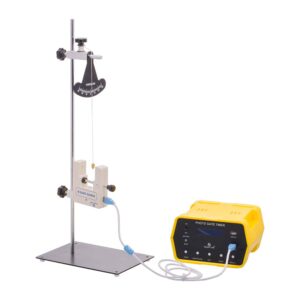
This setup clearly demonstrates simple harmonic motion and the conservation of energy. In simple harmonic motion, pendulum swings evenly from side to side. Use photogate timer to accurately measure the period of the pendulum or the speed of the pendulum bob at the bottom of the swing. The length of the string can be adjusted to measure the change in period. Also see the effect of change in mass on the period. Two pendulum bobs are provided. The setup includes a Photogate and Timer (PH10538T) for precise measurement of the pendulum’s period and bob speed.
PH10426R -
Mechanics
Rotational Motion Apparatus
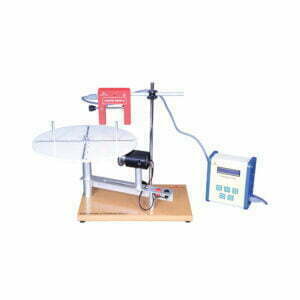
Explore the relationship between linear (tangential) and angular velocity with this setup. A DC-driven motor produces various rotational velocity at various distances from the motor. Different radii are drawn on the disk and pegs can be positioned at specific radii. A photogate may be attached as well, so the time of one rotation is easily measured. Students will then make measurements to calculate the angular velocity, which will be constant for a given motor speed independent of position. However, the tangential velocity will vary based on the radius of the circular path. Kit includes a rotational table, ruler and calipers. Required but not included are a 6 V power supply and a photogate system.
PH10428 -
Mechanics
Inertia Apparatus
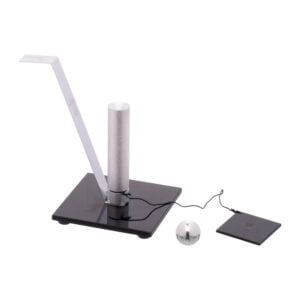
Demonstrate the principle of inertia. Comprises an aluminum rod mounted on a plastic base. Rod has a recessed top to take the spherical ball. When striker is pulled back and released the card square is propelled, but the ball unaffected and falls into the recess. Supplied complete with spherical ball and card square.
PH10512 -
-
Mechanics
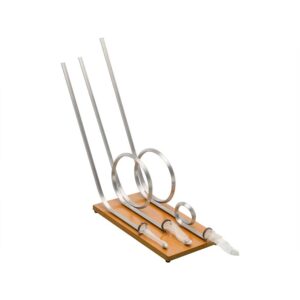
Loop the Loop Triple Track
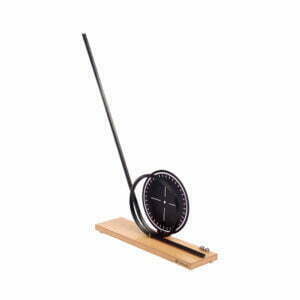
Understanding the principles of physics that occur on a roller coaster has become easier. This triple play apparatus consists of three tracks – one straight down, one with one loop, and the third with two loops. All three have different straight-up track lengths. At the end of each track is a catch sack to prevent losing the ball.
Straight track is 28 in. L, one loop track is 54 in. L with an 8 in. dia. loop, and two loop track is 70 in. L with a 3-1/2 in. dia. loop and 8 in. dia. loop, all on a 15-3/4 in. x 9-1/2 in. x 5/8 in. wooden base. Includes two steel balls (5/8 in. dia. and 3/4 in. dia.)
PH10515B


 +1 (630) 345-3450