
-
Magnetism
Magnetic Induction Circuit Board
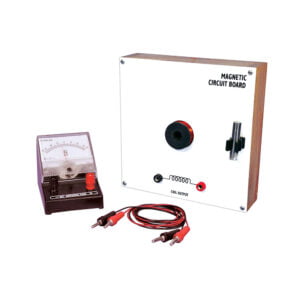
It is an apparatus to demonstrate the fundamentals of magnetic induction. Students can find relationship between magnetic field strength and induced voltage. The unit is complete with a coil fixed in the board, a cylindrical magnet, a pair of connecting leads and a galvanometer. With instruction manual.
PH41157 -
-
Magnetism
Variable Electromagnet
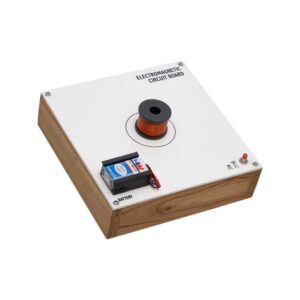
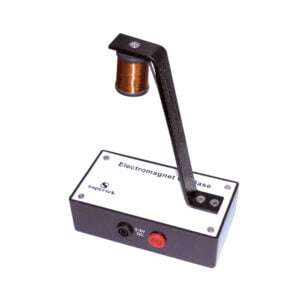
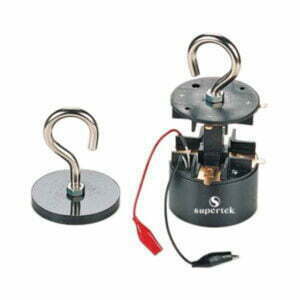
The variable coil electromagnet has 6 different coil options: 100, 200, 300, 400, 500 and 600 coils. A steel hook underneath gives students the opportunity to measure the strength of the magnetic field generated by varying different numbers of coils. A variable D.C. low voltage supply is required.
PH41164 -
Magnetism
Demonstration Relay
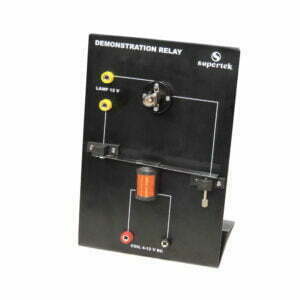
This Relay Demonstration Unit allows the investigation and study of how a relay functions in a clear and practical manner. A useful property of this Demonstration Relay Unit is that the circuit powering the coil is easily seen to be completely separate from the circuit-switched on by the relay. This is one of the reasons relays are used where a safe low-voltage circuit can be used to control a high-voltage circuit. When a current flows through the coil an electromagnetic field is produced. This field attracts the iron armature whose end makes the contact, completing the circuit and illuminating the Lamp. When the current is switched off, the contact will open again, switching the circuit off.
PH41165 -
Magnetism
Iron-Clad Electromagnet
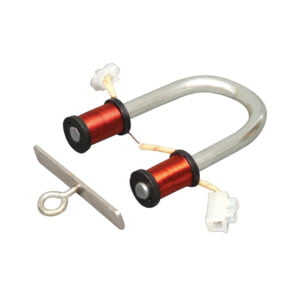
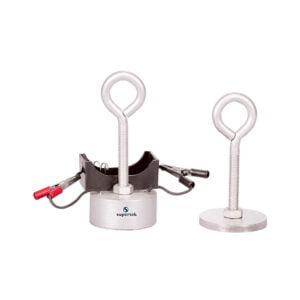
Used to demonstrate that how electric energy is converted into a very strong magnetic field. The precision machined contact surface makes this electromagnet so strong that it generates tremendous lifting power. The electromagnet is consists of core and yoke with vertically fitted four ‘D’ type cell holders around the electromagnet. The core has a cylindrical coil wound with enameled copper wire on annular insulated bobbin. It can also be operated with 6V/2Amp DC power supply.
PH41167D -
Magnetism
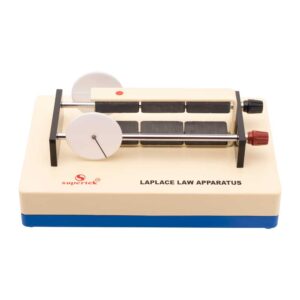
Force on a Conductor in a Magnetic Field (Laplace Law)
To demonstrate the electromagnetism. A pair of powerful magnets in U shape holder. A pair of brass rail with 4 mm socket is used for demonstration. A brass axle with two plastic discs is free to roll along the rails and complete the circuit between rails. As the axle placed on the rails near the poles of magnets and power supplied to the rails, the axle repelled and rolls away from the center of magnetic field along the rails.
PH41170 -
Magnetism
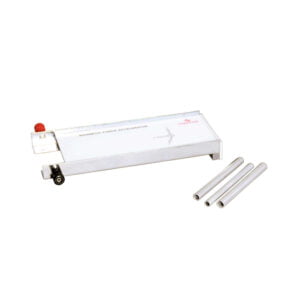
Magnetic Force Accelerator
A ramp with metal sides is filled with permanent magnets, North Pole up, covered with a large label. Three Aluminium tubes of different diameters can be placed in turn across the ramp, connecting the metal sides. A 12V DC voltage is applied to the sides of the ramp so that a large current flows (up to 15A). The Aluminium tube is immediately accelerated rapidly along the ramp and shoots off the end, breaking the circuit. As well as confirming the Right Hand Rule, students can observe the difference in the current drawn by the tube when the ramp is horizontal and when one end is raised using the included wooden prop. Requires a power supply that can deliver 12VDC/15A, not included.
PH41170M -
Magnetism
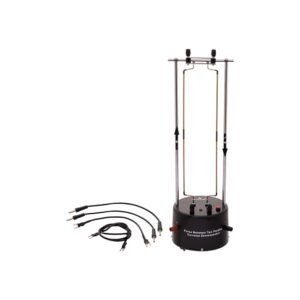
Force Between Conductors Demonstrator
An easy and safe way to demonstrate the magnetic force between two current carrying parallel conductors. A cylindrical base, containing a dedicated power supply, supports a rectangular frame. Attached inside the frame are two parallel heavy duty metal tubes supported by fine cone bearings which also supply current to the tubes. The directions of the currents in the tubes can be selected, and movable metal arrows on the frame uprights indicate the current direction in each tube. A push button applies a large current at low voltage to the tubes, which then swing together or apart, depending on whether the tube currents are in the same or opposite directions.
PH41171 -
Magnetism
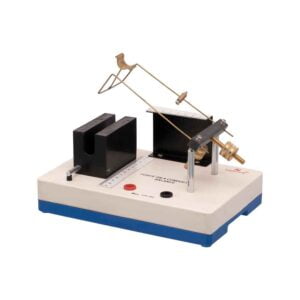
Force on a Conductor Balance
To demonstrate that when a current is passed through a conductor in a magnetic field, it is subjected to attraction or repulsion depending upon the direction of current in it. The apparatus consists of a plastic base 9″ x 6″ x 1″ on which two contact pillars are mounted. Each pillar is provided with an external circuit. A balanced beam is supported by the pillars on two bearings which form the fulcrum. Two screwed masses are provided in the beam system, one moving vertically for the adjustment of sensitivity and the other moving horizontally for the adjustment of the equilibrium position, when no current is flowing. Scale is marked 0-80 x 1 mm and rider is of 1 gm. Includes instruction manual.
PH41172B -
Magnetism
B.I.L Coil
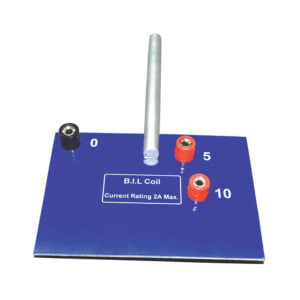
A printed circuit board coil with 5 and 10 turns. It can be placed between the poles of a permanent magnet on the top pan of a digital balance so that when a current is passed through it, a force is exerted on the magnet due to the magnetic effect of the current. Quantitative measurements can be taken to investigate the formula F = BIL.
PH41173 -
Magnetism
Helmholtz Coils
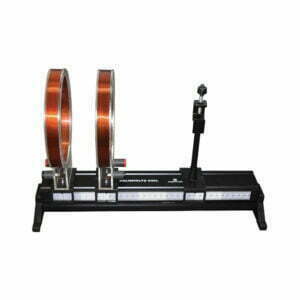
Helmholtz Coils are a special arrangement of coils that are placed in such a way as to generate a very uniform magnetic field between them when a current is applied. The strength of the magnetic field is proportional to the number of turns in the coils and the current applied to them. The Supertek Helmholtz Coils setup consists of two field coils mounted on a track to provide a uniform magnetic field between the coils. The proper separation for Helmholtz coils is marked on the track. A pair of precision coils and 400 turns of wire are wound on heat-resistant former of about 150 mm diameter.
PH41176 -
Magnetism
Helmholtz Coil
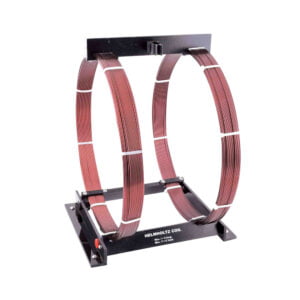
Pair of coils for generating a uniform magnetic field perpendicular to the axis of a tube.
Specifications:
- Coil diameter: 300 mm approx.
- Coil spacing: 150 mm.
- Number of turns per coil: 124.
- Enamelled copper wire thickness: 1.2 mm.
- DC resistance: 2 Ohms each.
- Maximum coil current: 5.5 A.
- Maximum coil voltage: 6 V.
- Maximum flux density at 5 A: 2 mT.
PH41176B -
Magnetism
Magnetometer
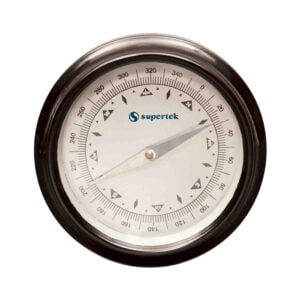
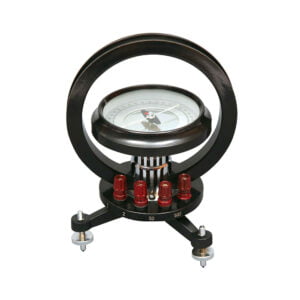
A plastic box with aluminium dial graduated in 0 – 90° four times, anti-parallax mirror and steel pivot. The short magnetic needle has a synthetic sapphire bearing and a light aluminium pointer designed for precise readings and maximum damping. The compass box has a hollow circular cavity to fit tangent galvanometer stand or deflection magnetometer base.
PH41180 -

 +1 (630) 345-3450