
-
Magnetism
Magna Probe
A tool for visualizing the three-dimensional nature of magnetic fields. The sensitive probe allows students to observe magnetic effects in space with clarity. Ideal for individual or group experiments, it provides an engaging way to understand complex concepts in physics through hands-on learning.
Features:
- Small Alnico bar magnet with clear N–S marking
- Non-magnetic gimbal mount for free movement in X, Y, Z axes
- Highly sensitive probe for precise demonstrations
- Approximate Dimensions: 120 mm (head width) × 280 mm (length)
PH40085 -
Magnetism
Magnetic Pendulum
The Random Oscillating Magnetic Pendulum (ROMP) is a popular desktop toy. It consists of a pendulum, with a small magnet attached to the end, which can swing freely over a metal base. On the base there are nine numbers of strong, disc-shaped magnets, which act on the pendulum with either an attractive or repulsive force. When the pendulum is displaced and released, it tends to swing in an erratic, unpredictable pattern. Due to friction, the pendulum eventually comes to rest over one of the magnets.
PH40098 -
Waves & Sound
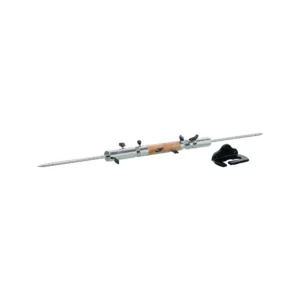
Reversible Compound Kater’s Pendulum
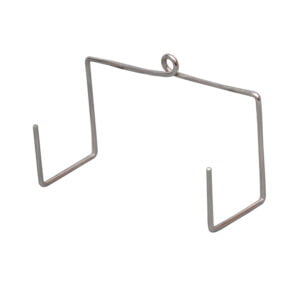
Kater’s pendulum includes a 120 cm electroplated brass rod (10 mm dia.) with small and large adjustable brass/wooden masses, two steel knife edges in adjustable holders, and a wall-mount support bracket.
Highlights:
- Provides accurate determination of gravitational acceleration (g).
- Durable construction ensures long-term classroom and lab use.
- Includes User Instruction Manual for students.
PH40099A -
Waves & Sound
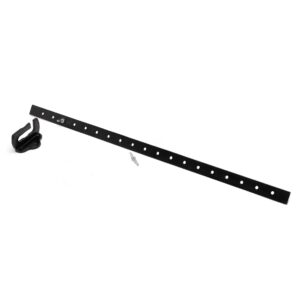
Compound Pendulum
This compound pendulum consists of a 1 m steel bar drilled at 50 mm intervals, with removable knife edges and a wall-mountable support bracket. It offers a sturdy design for repeated use and delivers consistent, reliable results for classroom demonstrations and experiments.
Highlights:
- 1 m steel bar with holes at 50 mm intervals for varied pivot points.
- Removable knife edges with wall-mount bracket for stable setup.
- Provides durable construction and repeatable results for accurate study.
- Accompanied by User Instruction Manual.
PH40099B -
Magnetism
Magnetic Field Demonstrator, Acrylic
An elegant method for displaying the shape of magnetic fields without using iron filings. Ideal for student investigations or for demonstration using an overhead projector. The transparent plate is comprised of a matrix of small circular chambers. Each chamber contains an iron rod and functions independently as a plotting compass.
PH40100P -
-
Magnetism
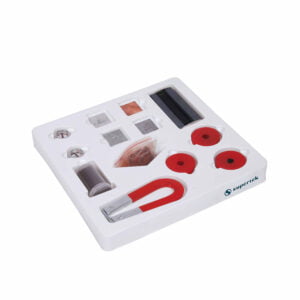
Magnetic Kit
A kit of magnets and accessories in a storage tray.
Contents :
- One Horseshoe magnet, 100 mm, with keepers. Two ceramic bar magnets, 75 mm long.
- Three ceramic ring magnets, 38 mm diameter.
- Two plotting compasses clear both sides, 19 mm diameter.
- One lodestone specimen.
- One pack Iron Filing.
- One each strip of Iron, Aluminium, Zinc and Copper metal.
PH41130 -
Magnetism
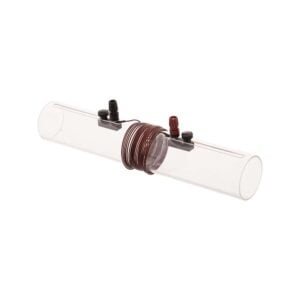
Variable Magnetic Field Coil
An enamelled copper wire solenoid is wound on a clear acrylic tube. The extreme ends of the solenoid are movable and the magnetic field can be varied by moving the extreme ends. 4mm sockets are provided to apply the current across the solenoid. Coil Diameter 60 mm, Length 350 mm.
PH41150 -
Magnetism
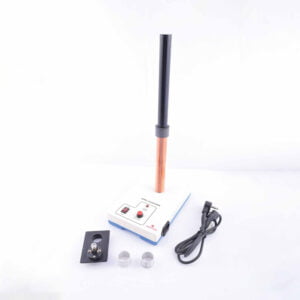
Ring Launcher
The ring launcher consists of a vertically mounted solenoid of thick copper wire with an iron core. The coil is energized with by pressing the push button on the panel. Two aluminum rings are supplied with the apparatus. These rings fit over the solenoid and are supported at some height above the base by adjustable collar. The behaviour of the rings when the coil is energized depends on the type of the ring placed over the coil at the time. The solid aluminum ring is propelled straight up while the slotted ring remains static, thus demonstrating the principle of electromagnetic induction as well as Lenz law.
PH41154 -
Magnetism
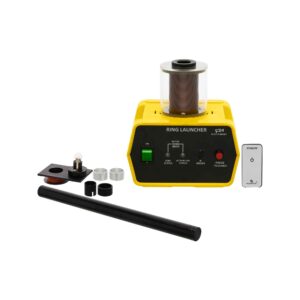
Ring Launcher
To demonstrate the Lenz’s law and effects of electromagnetically induced currents. A ring launcher consist of the base unit and built-in vertical solenoid of thick copper wire with a removeable iron core. Launch rings are provided with launcher includes: aluminum ring without split, aluminium ring with split and a plastic ring. These rings fit over the solenoid and are supported at some height above the base by an adjustable collar.
Unique characteristics:
- Circuit activation by insertion of solenoid.
- Buzzer for the confirmation of activation.
- IR remote for safe & controlled launch.
- Designed for use in school/college laboratories.
- Rigid housing with the indication of power, activation status & core status.
- Press to launch switch.
Key topics
- Electromagnetic Induction
- Magnetic Flux
- Faraday Law
- Lenz Law
- Eddy current
- Self-induction
- Mutual-induction
PH41154A -








 +1 (630) 345-3450