
Benchtop Equipment: Expert Guide to Selection, Performance, and Reliable Laboratory Operations
Benchtop equipment plays a decisive role in the accuracy, efficiency, and safety of laboratory operations. Unlike large floor-mounted systems, benchtop instruments are used directly at the point of experimentation, making their reliability critical to daily laboratory workflows.
From sterilization and controlled heating to mixing, distillation, and analytical testing, benchtop equipment supports core laboratory functions across educational institutions, pharmaceutical companies, chemical industries, research laboratories, and testing facilities. Laboratories in India and the USA depend on high-quality benchtop equipment to maintain controlled conditions, repeatable results, and operational compliance.
What Is Benchtop Equipment
- Consistent and repeatable performance
- Controlled temperature and process parameters
- Space-efficient laboratory layouts
- Easy monitoring and safe operation
Core Types of Benchtop Equipment and Their Laboratory Applications
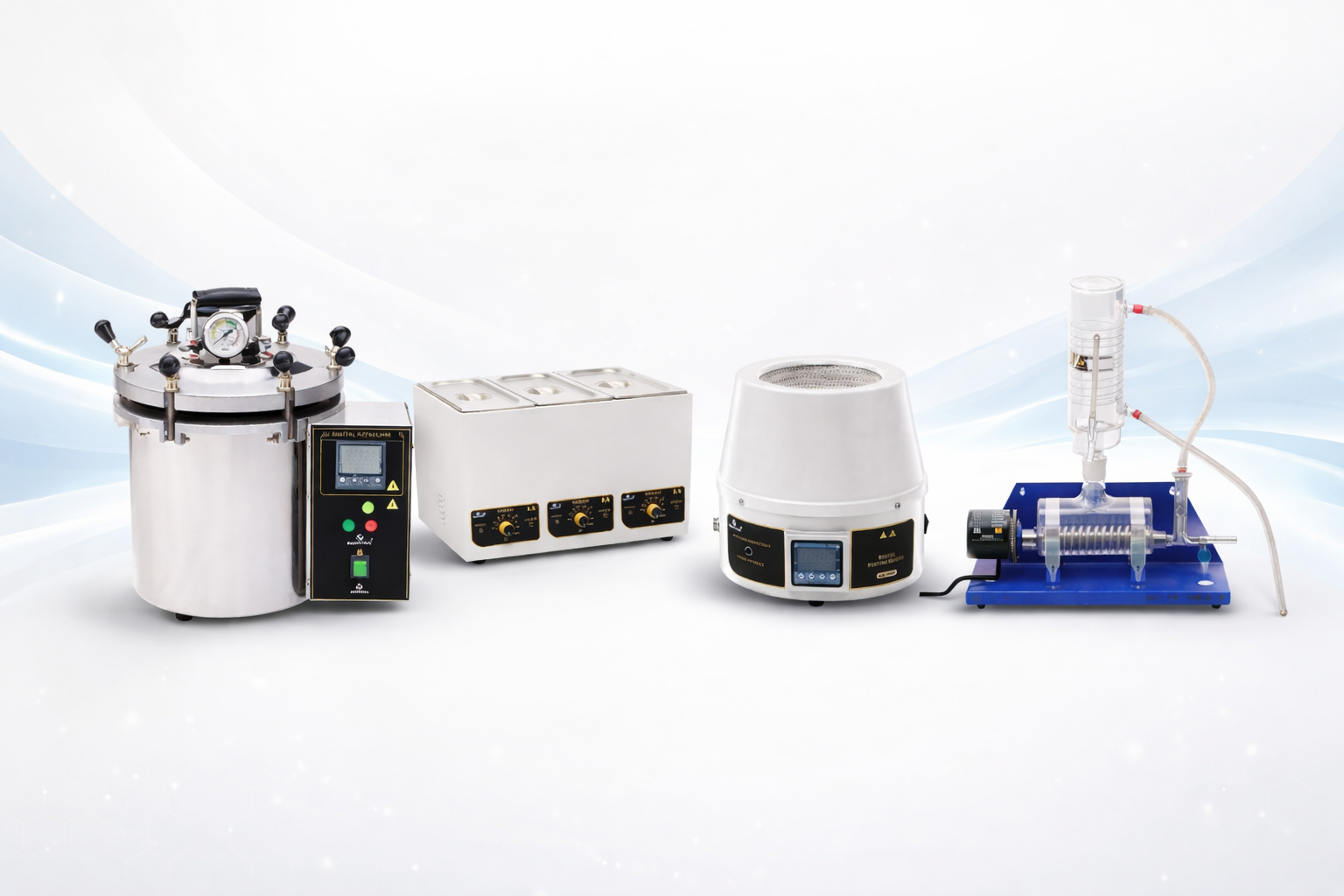
Autoclaves
Benchtop autoclaves are essential for sterilizing laboratory instruments, glassware, and media. They are widely used in microbiology, pharmaceutical, clinical, and research laboratories where contamination control is critical.
Expert insight: Inconsistent pressure regulation and inadequate chamber insulation are common issues in low-quality autoclaves, leading to unreliable sterilization cycles.
Water Baths
Water baths provide uniform and controlled heating for samples that require stable temperature conditions. They are extensively used in biotechnology, pharmaceutical quality control, and chemical testing laboratories.
Expert insight: Temperature stability across the bath is often more important than maximum temperature range for routine laboratory applications.
Heating Mantles
Heating mantles are designed for safe and even heating of round-bottom flasks and glass vessels. They are preferred over open-flame heating in chemical synthesis and distillation due to improved safety and thermal control.
Expert insight: Poor insulation and uneven heating elements can cause localized overheating and stress on laboratory glassware.
Distillation Apparatus
Benchtop distillation apparatus is used for separation and purification of liquids based on boiling point differences. It is a fundamental setup in chemistry laboratories and industrial testing environments.
Expert insight: Precision in joint fitting and thermal balance directly affects separation efficiency and repeatability.
Kjeldahl Units
Kjeldahl units are used for nitrogen and protein estimation in food testing, agriculture, environmental analysis, and pharmaceutical laboratories.
Expert insight: Material resistance to corrosive chemicals is a key factor affecting safety and long-term performance.
Magnetic Stirrers
Magnetic stirrers enable uniform mixing of solutions during chemical reactions and preparation processes. They are a standard benchtop instrument across laboratory disciplines.
Expert insight: Stable speed control at lower RPM is often more valuable than high-speed capability.
Vortex Mixers
Vortex mixers are used for rapid mixing of small sample volumes in tubes and vials. They are widely used in diagnostic, analytical, and research laboratories.
Hot Plates
Benchtop hot plates provide controlled heating for laboratory procedures and are often combined with stirring functions to improve process control.
Melting Point Apparatus
Melting point apparatus is used to determine melting temperatures, which are critical for purity testing and material identification in chemical and pharmaceutical laboratories.
Build Quality and Material Standards in Benchtop Equipment
The long-term reliability of benchtop equipment depends heavily on construction quality and material selection. Equipment manufactured using high-quality raw materials demonstrates better thermal stability, structural integrity, and resistance to laboratory environments.
A fine-finish, structured powder-coated body provides:
- Enhanced corrosion resistance
- Protection against chemical splashes
- Improved durability under daily laboratory use
- Easier cleaning and maintenance
These factors directly influence equipment lifespan and operational safety.
Accuracy, Safety, and Calibration Stability
Accuracy is a defining requirement for benchtop equipment. Temperature control, stirring speed, pressure regulation, and analytical measurements must remain stable across repeated operating cycles.
Reliable benchtop equipment supports:
- Consistent calibration performance
- Minimal measurement drift
- Safe operation through thermal cutoffs and protective housing
- Compatibility with laboratory validation protocols
Laboratories operating under regulated environments require equipment that maintains performance consistency over time.
Common Issues with Low-Quality Benchtop Equipment
From manufacturing and field experience, laboratories commonly face issues such as:
- Inconsistent temperature control
- Premature corrosion due to inferior surface coatings
- Electrical instability and component failure
- Difficulty in calibration and maintenance
These issues increase downtime, compromise safety, and affect result reliability.
Industries That Rely on Benchtop Equipment
Educational Institutions
Schools, colleges, and universities rely on benchtop equipment for practical laboratory training across chemistry, biology, physics, and applied sciences. Equipment such as hot plates, magnetic stirrers, water baths, and melting point apparatus supports hands-on learning while maintaining controlled and safe laboratory conditions.
Pharmaceutical and Chemical Industries
Pharmaceutical and chemical industries depend on benchtop equipment for formulation development, quality control, and analytical testing. Heating mantles, distillation apparatus, magnetic stirrers, and hot plates play a critical role in controlled reactions and process validation.
Accuracy, thermal stability, and material durability are essential to ensure compliance and repeatable results.
Research and Testing Laboratories
Research institutions and independent testing laboratories require benchtop equipment that delivers precise, repeatable performance over extended use. Instruments such as vortex mixers, water baths, and analytical heating systems support experimental consistency and data integrity.
Food, Agriculture, and Environmental Testing
Food, agriculture, and environmental testing laboratories rely on benchtop equipment such as Kjeldahl units and water baths for nitrogen estimation, sample preparation, and regulated analysis. Durability, chemical resistance, and operational safety are particularly important in these environments.
How to Choose the Right Benchtop Equipment Supplier
Selecting the right supplier is as important as selecting the equipment itself. Buyers should evaluate suppliers based on manufacturing quality, application understanding, and long-term reliability.
Key factors to assess include:
- Use of high-quality raw materials
- Durable powder-coated construction
- Consistent operational accuracy
- Suitability for institutional and industrial laboratories
- Availability of technical documentation and support
A dependable supplier ensures reduced risk and sustained performance.
Benchtop Equipment Supply and Quality Focus at Supertek
Supertek supplies a comprehensive range of benchtop equipment including autoclaves, water baths, heating mantles, distillation apparatus, Kjeldahl units, magnetic stirrers, vortex mixers, hot plates, and melting point apparatus.
All equipment is manufactured using high-quality raw materials and finished with precision-structured powder coating to ensure durability, corrosion resistance, and long service life. The focus remains on functional reliability, operator safety, and compatibility with laboratory workflows for customers in India, the USA, and international markets worldwide.
Conclusion
Benchtop equipment directly influences laboratory accuracy, safety, and efficiency. From sterilization and controlled heating to analytical testing and mixing, these instruments form the operational core of modern laboratories.
By combining robust construction, stable performance, and application-focused design, suppliers like Supertek support laboratories in India and the USA with dependable benchtop equipment suited for educational, research, pharmaceutical, chemical, and industrial environments. Choosing the right benchtop equipment manufacturer and supplier ensures long-term reliability, reduced operational risk, and consistent laboratory outcomes.


 +1 (630) 345-3450