
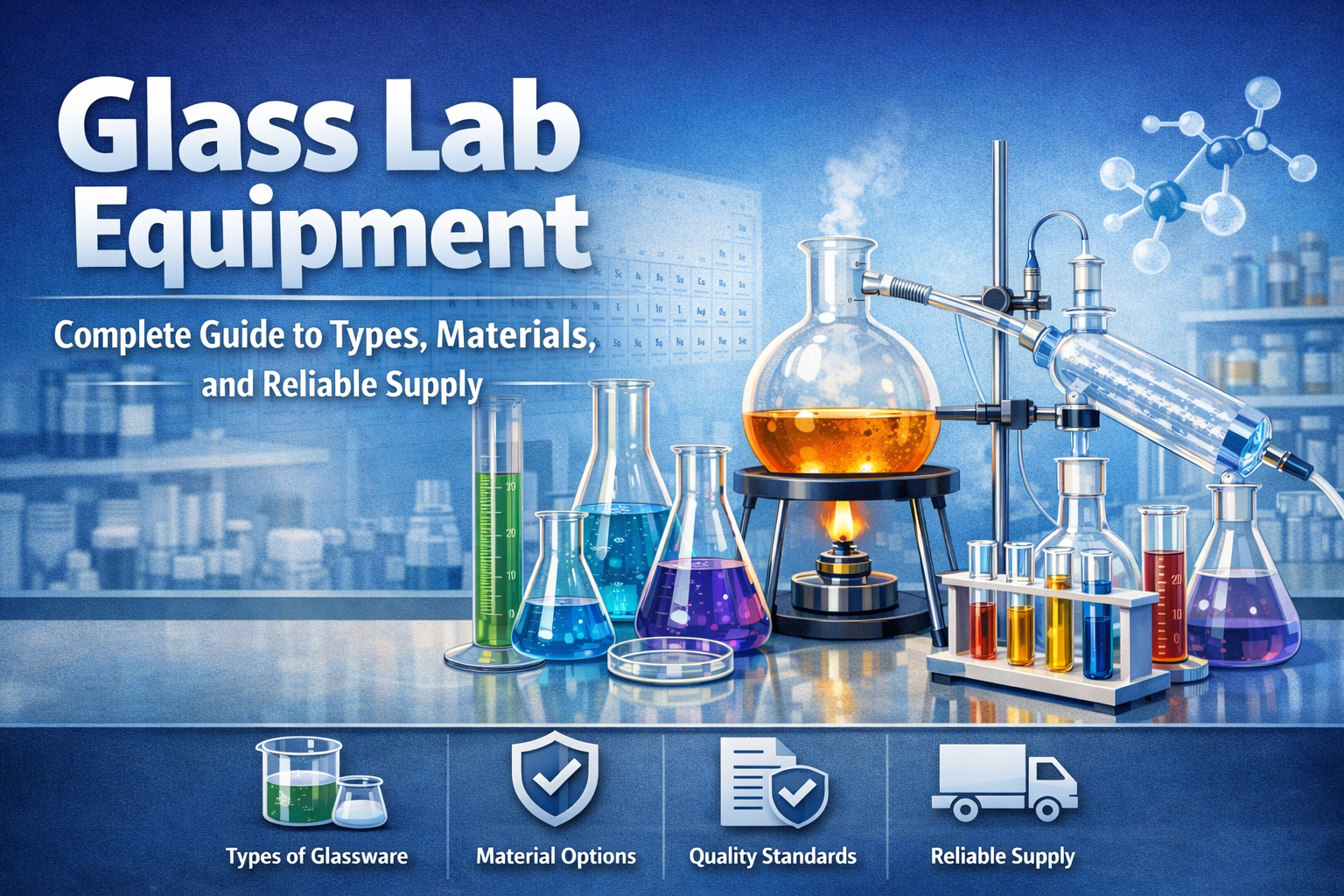
Glass lab equipment is fundamental to scientific accuracy, safety, and repeatability in laboratories worldwide. From educational institutions and pharmaceutical companies to chemical industries and research laboratories, laboratory glassware plays a direct role in ensuring precise measurements, controlled reactions, and contamination free processes.
Unlike generic containers, glass lab equipment is engineered to withstand chemical exposure, thermal variation, and repeated laboratory use. Laboratories in India and the USA depend on high quality glassware to meet regulatory requirements, maintain experimental integrity, and support long term operational reliability.
What Is Glass Lab Equipment
Glass lab equipment refers to scientific instruments manufactured using laboratory grade glass for applications such as measuring, mixing, heating, storing, and analyzing chemical and biological substances.
Well manufactured glass lab equipment provides:
- Accurate volume measurement
- High chemical resistance
- Thermal shock resistance
- Clear visibility during experiments
- Long service life under laboratory conditions
Because of these factors, laboratory glassware is used across controlled environments where precision and safety cannot be compromised.
Types of Glass Lab Equipment and Their Applications
Beakers
Beakers are one of the most widely used forms of glass lab equipment. They are used for mixing, heating, dissolving, and holding liquids. Beakers are common in academic laboratories, chemical processing units, and quality control labs.
Flasks
Flasks are essential laboratory glassware designed for reactions, boiling, and storage. Common types include:
- Conical flasks for mixing and titration
- Volumetric flasks for precise solution preparation
- Round bottom flasks for heating and distillation
Each type supports different laboratory processes where accuracy and stability are required.
Test Tubes
Test tubes are basic but critical glass lab equipment used for sample testing, reactions, and observation. They are widely used in educational, diagnostic, and research laboratories.
Measuring Cylinders
Measuring cylinders are used for accurate volume measurement of liquids. Clear graduations and dimensional precision are vital for reliable laboratory results.
Pipettes and Burettes
Pipettes and burettes are precision based glass lab equipment used in titration and controlled liquid transfer. Accuracy, calibration consistency, and smooth flow are key quality indicators.
Funnels, Condensers, and Specialized Glassware
Glass funnels support filtration and transfer processes, while condensers are used in distillation and reflux systems. These components are essential in chemical synthesis and pharmaceutical laboratories.
Materials Used in Glass Lab Equipment
Funnels, Condensers, and Specialized Glassware
Borosilicate glass is the most widely used material in high quality glass lab equipment. It offers:
- Excellent resistance to thermal shock
- Low thermal expansion
- High chemical durability
- Stability under repeated heating and cooling
This makes borosilicate glass suitable for advanced laboratory and industrial applications.
Soda Lime Glass
Soda lime glass is used in basic laboratory glassware where extreme temperature resistance is not required. It is commonly used in educational and low risk laboratory environments.
Why Material Quality in Glass Lab Equipment Matters
The performance of glass lab equipment depends heavily on material purity, wall thickness uniformity, and manufacturing precision. Poor quality glassware can crack under heat, distort volume readings, or contaminate samples.
Laboratories in regulated environments require laboratory glassware that delivers consistent results while maintaining safety standards over extended periods of use.
Manufacturing Standards, Accuracy, and Safety Considerations
High quality glass lab equipment is produced using controlled manufacturing processes that focus on precision forming and proper annealing. These processes reduce internal stress and improve durability.
Key safety and accuracy factors include:
- Uniform wall thickness
- Clear and accurate graduation markings
- Smooth edges for safe handling
- Resistance to thermal shock and chemical exposure
Well manufactured laboratory glassware reduces breakage risk and supports safe laboratory operations.
Industries That Rely on Glass Lab Equipment
Educational Institutions
Schools, colleges, and universities use glass lab equipment for practical learning in chemistry, biology, and physics laboratories.
Pharmaceutical Industry
Pharmaceutical laboratories depend on laboratory glassware for formulation, testing, research, and quality control processes where precision is critical.
Chemical Industry
Chemical research and production facilities use glass lab equipment for reactions, distillation, and analytical testing.
Research and Testing Laboratories
Independent research centers and industrial testing labs require reliable glass lab equipment for accurate and repeatable results.
How to Choose the Right Glass Lab Equipment Supplier
For buyers in India and the USA, selecting the right supplier is essential. Key evaluation factors include:
- Use of high grade borosilicate glass
- Consistency in dimensions and graduations
- Compliance with laboratory quality standards
- Batch to batch production reliability
- Capability to supply standard and custom glass lab equipment
A dependable supplier also ensures safe packaging and damage free delivery, especially for bulk and export orders.
Quality Checks, Certifications, and Durability
Reputed manufacturers of glass lab equipment follow strict quality inspection procedures. These typically include:
- Visual inspection for defects
- Dimensional accuracy checks
- Thermal resistance testing
- Chemical durability evaluation
Such quality controls ensure laboratory glassware performs reliably under real laboratory conditions and maintains long service life.
Glass Lab Equipment Manufacturing at Supertek
Supertek manufactures glass lab equipment with a focus on material integrity, dimensional accuracy, and durability. The manufacturing process emphasizes controlled forming, uniform wall thickness, and proper annealing to meet laboratory performance requirements.
Each stage of production is monitored to ensure consistency and safety. The glass lab equipment produced is suitable for educational institutions, research laboratories, pharmaceutical companies, and chemical industries in India and the USA, supporting both domestic and international laboratory standards.
FAQs
We manufacture lab glassware that is resistant to corrosion, chemicals, and heat and is composed of heat resistant borosilicate 3.3 glass. At Shiv Dial Sud & Sons, get a wide range of laboratory glassware that includes Flasks, beakers, measuring cylinders, test tubes, pipettes, burettes, interchangeable glassware, volumetric glassware, columns, sintered glassware, condensers, and more. We have been in this industry for 80 years now, thus, our experience speaks volumes about our quality products.
Borosilicate glass is preferred due to its thermal resistance and chemical stability.
It withstands high temperatures, sudden temperature changes, and chemical reactions without cracking or affecting sample integrity.
Glass lab equipment should be stored in clean, dry conditions with proper supports to prevent impact damage.
Yes, manufacturers can supply customized laboratory glassware based on size, application, and technical requirements.
With proper handling and storage, high quality laboratory glassware can last for many years.
Conclusion
Glass lab equipment is a critical component of safe, accurate, and efficient laboratory operations. From material selection and manufacturing standards to supplier reliability, every factor influences laboratory performance and safety.
By maintaining precision driven manufacturing and quality focused processes, Supertek supports laboratories in India and the USA with dependable glass lab equipment suited for educational, industrial, and research applications. Choosing high quality laboratory glassware ensures consistency, compliance, and long term operational value.


 +1 (630) 345-3450