
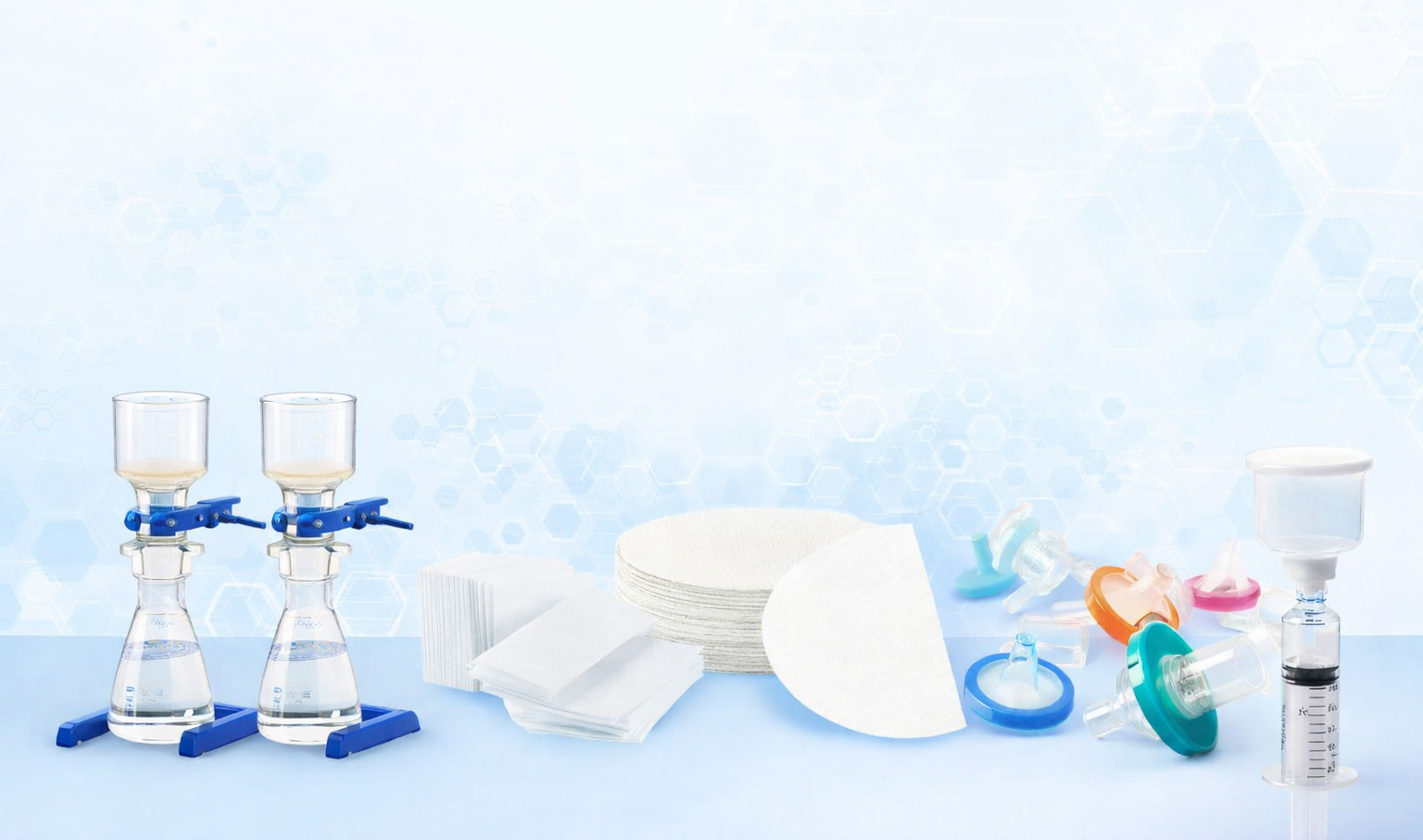
Complete Guide to Laboratory Filtration Equipment
Filtration is one of the most common and essential processes used in laboratories across the United States. From separating solid particles in chemical experiments to sterilising pharmaceutical solutions and preparing samples for HPLC systems, filtration plays a critical role in ensuring accuracy and reliability in laboratory work. Selecting the correct laboratory filtration equipment helps prevent contamination, improve workflow efficiency, and protect sensitive analytical instruments.
Laboratories in the US typically rely on three core laboratory filtration products: filter papers, membrane filters, and syringe filters. Supertek, an ISO 9001:2015 certified manufacturer with over 80 years of experience and a US office in Addison, Illinois, supplies all three to research labs, universities, pharmaceutical companies, and industrial facilities across the United States.
This guide explains each product, when to use it, and how to choose correctly.
What Is Laboratory Filtration?
Laboratory filtration is the process of separating suspended particles from liquids or gases by passing the mixture through a porous material. The filtration medium acts as a barrier that traps particles above a certain size while allowing the clean liquid, known as the filtrate, to pass through.
Filtration is widely used across industries such as pharmaceuticals, biotechnology, environmental testing, food quality control, and chemical research all sectors with significant laboratory activity across the US. Proper filtration ensures accurate analytical results, prevents contamination, and protects laboratory instruments from particle damage.
The most important factors when selecting filtration equipment are pore size, material compatibility, flow rate, and whether sterile filtration is required.
Filter Papers
Supertek filter papers are manufactured from high-purity virgin cellulose fibre and are among the most widely used filtration materials in US laboratories. They work alongside laboratory glassware, such as glass funnels, filter flasks, and beakers, with the fibre matrix retaining solid particles while the liquid passes through cleanly.
There are two main types of laboratory filter papers:
Qualitative Filter Papers
Qualitative filter papers are used for routine filtration tasks where the mass of the collected particles is not important. They are widely used in US teaching laboratories, general chemistry experiments, and environmental sample preparation. Supertek supplies qualitative grades 1 through 5, covering pore sizes from 2.5 µm to 25 µm.
Quantitative Filter Papers
Quantitative filter papers contain very low ash content and are designed specifically for gravimetric analysis. In these applications, the filter paper is weighed before and after filtration to determine the mass of the collected precipitate accurately. Supertek’s quantitative grades S40, S41, and S42 meet the precision requirements of US pharmaceutical QC and analytical chemistry labs.
Membrane Filters
Supertek membrane filters are designed for high precision filtration and are used in microbiology, pharmaceutical production, and analytical laboratories across the US. Unlike filter papers, membrane filters are manufactured from synthetic polymer materials with a uniform pore structure that allows highly consistent and repeatable filtration performance.
Because of their precise pore size control, membrane filters can remove extremely fine particles and microorganisms. The most commonly used pore sizes in US labs are:
- 0.22 µm — sterilising filtration and bacterial removal in pharmaceutical and biotech applications
- 0.45 µm — clarification and fine particle removal, widely used in HPLC sample preparation and microbiology
- 0.8 µm or larger — pre-filtration and coarse clarification before a finer membrane stage
Membrane filters are essential in US pharmaceutical laboratories, biotechnology research facilities, clinical testing environments, and environmental monitoring programs where microbial removal and sterile filtration are regulatory requirements.
Syringe Filters
Supertek syringe filters are compact, single-use filtration devices that attach directly to a standard luer-lock syringe. They are the most practical solution for filtering small liquid samples quickly in analytical laboratories across the United States, particularly for HPLC and chromatography sample preparation, where removing fine particles protects expensive analytical columns and improves measurement accuracy.
Supertek syringe filters are available in both sterile and non-sterile versions and in multiple pore sizes, most commonly 0.22 µm and 0.45 µm. They are colour-coded for fast identification in busy US lab environments: 0.22 µm filters are pink, and 0.45 µm filters are blue. Designed for volumes between 1 ml and 100 ml, they are widely used in US pharmaceutical research, biotechnology, environmental testing, and food quality control labs.
Filter Paper vs Membrane Filter vs Syringe Filter
Although these filtration tools serve similar purposes, they are designed for different laboratory requirements. Use this quick reference to identify the right product for your application:
Feature | Filter Paper | Membrane Filter | Syringe Filter |
Pore Size | 2.5 – 25 µm | 0.1 – 10 µm | 0.1 – 5 µm |
Sterile Option | No | Yes (0.22 µm) | Yes |
Bacterial Removal | No | Yes | Yes (0.22 µm) |
Volume Capacity | Any volume | Medium to large volumes | 1 – 100 ml |
Best For | General separation, gravimetric analysis | Sterilisation, microbiology, biotechnology | HPLC preparation, small sample filtration |
Common Use in US Labs | Teaching laboratories, chemical QC | Pharmaceutical labs, environmental testing, biotech research | Analytical labs, pharmaceutical testing, food quality control |
How to Choose the Right Laboratory Filter
Selecting the correct filtration equipment becomes easier by working through four questions:
- What particle size needs to be removed?
Larger particles use filter papers. Very fine particles or microorganisms require membrane or syringe filters. - What volume is being filtered?
Large volumes use funnel or vacuum systems. Small analytical samples use syringe filters. - Is sterility required?
Pharmaceutical, cell culture, and microbiological applications require 0.22 µm-rated sterile membrane or syringe filters. - What chemicals are in the sample?
Some solvents require specific membrane materials such as nylon or PVDF to avoid degradation.
Explore Supertek Laboratory Filtration Products
Supertek manufactures a complete range of laboratory filtration equipment, including filter papers, membrane filters, and syringe filters, designed for research laboratories, pharmaceutical companies, and analytical testing facilities. Contact our US office in Addison, Illinois, to request product specifications or pricing.
Conclusion
Laboratory filtration is a critical process that supports accurate analysis, reliable experiments, and safe laboratory workflows across the United States. Filter papers are the right choice for general separation and routine tasks. Membrane filters deliver precise, sterile filtration for sensitive applications. Syringe filters offer the most convenient solution for small-volume analytical sample preparation.
Choosing the correct filtration equipment ensures better experimental results, protects laboratory instruments, and improves overall efficiency. US laboratories working in chemistry, pharmaceuticals, environmental testing, and biotechnology depend on high-quality, consistent filtration products to maintain regulatory compliance and scientific reliability.
FAQs
Qualitative filter papers are used for general filtration tasks where the weight of retained particles is not measured, routine separation, educational labs, and environmental sample prep. Quantitative filter papers have very low ash content (below 0.007%) and are designed for gravimetric analysis, where the filter is weighed before and after filtration to determine the exact mass of a precipitate. US pharmaceutical QC and analytical chemistry labs typically use quantitative grades S40, S41, or S42.
For sterilising filtration, removing bacteria from pharmaceutical solutions, cell culture media, or injectable preparations, a 0.22 µm-rated sterile membrane filter is required. This is the standard specification for US pharmaceutical and biotech labs. For clarification and fine particle removal without full sterilisation, 0.45 µm is the commonly used option in HPLC sample preparation and environmental testing.
For HPLC sample preparation in US analytical labs, 0.45 µm syringe filters are the standard for aqueous samples. Use 0.22 µm when working with aggressive mobile phases or when extra column protection is required. Always confirm the membrane material is compatible with your solvent. Nylon and PVDF offer the broadest chemical compatibility across organic solvents commonly used in US chromatography labs.
Yes. Supertek exports filter papers, membrane filters, and syringe filters to research laboratories, universities, pharmaceutical companies, and industrial facilities across the United States. Our US office is located at 15 W. Commercial Ave., Addison, IL 60101. You can reach our US team at +1 (630) 345-3450 or submit an enquiry through our website for pricing, MOQ, and lead time information.
No. Both syringe filters and membrane filters are single-use devices. Reusing them risks sample carryover contamination, membrane damage that compromises particle retention, and, in sterile applications, the introduction of microbial contamination. In regulated US laboratory environments, including pharmaceutical QC and environmental compliance testing, single-use filtration is a standard requirement to ensure result integrity and audit traceability.
Laboratory filtration equipment is widely used across industries, including pharmaceuticals, biotechnology, environmental testing, chemical research, food and beverage quality control, and academic laboratories. In the United States, filtration is essential for sample preparation, microbiological testing, and regulatory compliance in many laboratory processes.


 +1 (630) 345-3450