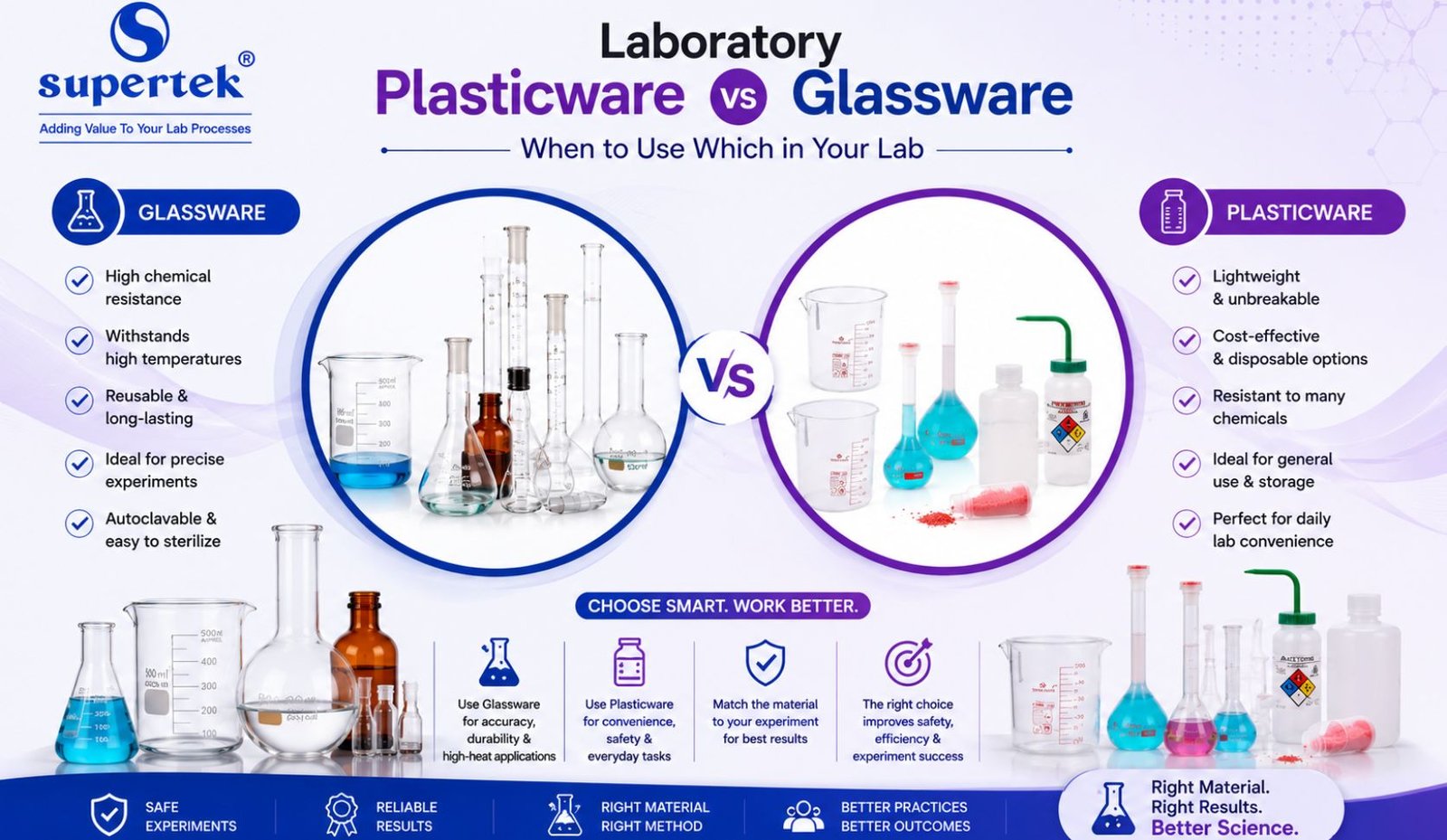
Laboratory plasticware and glassware serve different purposes in laboratories. Glassware is preferred for high-temperature reactions, chemical resistance, and precise measurements, while plasticware is ideal for safety, storage, and biological applications. Most laboratories use both materials depending on the experiment, chemical compatibility, and required accuracy.
If you have ever stood in front of a supply catalogue trying to decide between a glass beaker and a plastic one, you are not alone. It is one of the most common decisions faced by lab managers, educators, and procurement teams worldwide.
The answer is not “always glass” or “always plastic.” Each material has specific strengths, and choosing the right one directly impacts safety, accuracy, and cost. This guide explains when to use each, how to evaluate compatibility, and how to avoid costly mistakes.
Plasticware vs Glassware
- Use glassware for heat, precision, and chemical resistance
- Use plasticware for safety, storage, and routine handling
- Most laboratories use both, depending on the application
What Is Laboratory Glassware?
Laboratory glassware refers to equipment made from glass — typically borosilicate glass — used for measuring, mixing, storing, heating and conducting chemical reactions. It is the oldest and most trusted material in laboratory science.
The most important type for professional use is borosilicate 3.3 glass, which contains approximately 80% silica and 12–13% boron trioxide. This composition gives it exceptional resistance to thermal shock, most chemicals, and temperatures up to 500°C, properties that ordinary soda-lime glass does not have.
Common Types of Laboratory Glassware
- Beakers for mixing and heating
- Conical flasks for reactions and titrations
- Volumetric flasks for precise solutions
- Burettes for titration
- Pipettes for accurate transfer
- Test tubes for small-scale reactions
Explore more: laboratory glassware manufacturer and supply solutions
Borosilicate vs Soda-Lime Glass — Key Properties
Understanding the difference between borosilicate and soda-lime glass is critical when selecting laboratory glassware, as it directly affects safety, durability, and performance.
Property | Borosilicate 3.3 | Soda-Lime Glass |
Maximum Temperature | Up to 500°C | Up to 150°C |
Thermal Shock Resistance | Excellent — resists rapid temperature changes | Poor — prone to cracking under temperature variation |
Chemical Resistance | Excellent — suitable for most acids, bases, and solvents | Moderate — may react with certain chemicals |
Autoclavability | Suitable for repeated autoclaving | Not recommended for autoclaving |
Suitability for Laboratory Use | Professional standard for laboratory applications | Not suitable for high-performance lab use |
What Is Laboratory Plasticware?
Laboratory plasticware refers to equipment made from synthetic polymers. Unlike glassware, where the material is always glass, plasticware performance varies enormously depending on which polymer is used. Choosing the right polymer is just as important as choosing plastic over glass.
The Most Important Plastics in Laboratory Use
Different polymers have different properties, and selecting the right material is critical for safety, chemical compatibility, and performance.
Polymer | Abbreviation | Best For | Avoid For |
Polypropylene | PP (5) | Autoclavable applications, -20°C to 135°C, good chemical resistance | Strong oxidising acids at high concentrations |
High-Density Polyethylene | HDPE (2) | Flexible use, excellent chemical resistance, reagent storage | Organic solvents, temperatures above 80°C |
Polycarbonate | PC (7) | High clarity, rigid containers, centrifuge tubes | Concentrated acids, alkalis, organic solvents |
PTFE (Teflon) | PTFE | Maximum chemical resistance, suitable for highly aggressive chemicals | Very few limitations, but high cost |
Polystyrene | PS (6) | Disposable labware, cell culture, low-cost applications | Heat above 70°C, most organic solvents |
Polymethylpentene | PMP | Transparent like glass, heat-resistant up to 175°C | Concentrated acids, some halogenated solvents |
Common Types of Laboratory Plasticware
- Plastic beakers and bottles
- Centrifuge tubes
- Petri dishes
- Pipette tips
- Wash bottles
- Cryovials and storage containers
Explore more: laboratory plasticware supplier for global distribution
Laboratory Plasticware vs Glassware — Complete Comparison
Here is a side-by-side comparison of laboratory plasticware vs glassware based on the most important factors for laboratory decision-making:
Criteria | Laboratory Glassware | Laboratory Plasticware |
Heat Resistance | Excellent — up to 500°C (borosilicate) | Limited — typically 100–135°C (PP) |
Chemical Resistance | Excellent with most acids, bases and organic solvents | Varies by polymer — compatibility must be checked |
Breakage / Safety | Can shatter — risk of injury and contamination | Shatter-resistant — safer for routine use |
Weight | Heavier — can cause fatigue in repetitive tasks | Lightweight — easier for frequent handling |
Optical Clarity | Superior — ideal for colour observation and reactions | Good in PC/PMP, translucent in HDPE/PP |
Autoclavability | Fully autoclavable (borosilicate glass) | Only PP and PTFE — not suitable for PS or PC |
Sample Adsorption | Low — minimal interaction with samples | Higher — may bind proteins and lipids |
Measurement Accuracy | High precision — Class A glassware for accurate measurements | Not suitable for precision volumetric work |
Cost | Higher upfront cost — long lifespan | Lower initial cost — recurring replacement cost |
Environmental Impact | Reusable — lower long-term waste | Disposable — contributes to plastic waste |
Chemical Compatibility — The Most Critical Factor
Chemical Type | Best Material | Avoid |
Organic solvents | Glass, PTFE | PC, PS |
Strong acids | PTFE, PP | Some plastics |
Hydrofluoric acid | PTFE only | All glass |
Alkalis | PP, PTFE | Glass (long exposure) |
Special Cases: Filtration and Liquid Handling
Filtration -> Glass or Plastic?
For gravity filtration using laboratory filter papers, glass funnels are the standard; they resist chemical attack and are easy to clean. For syringe filters used in HPLC sample preparation, the housing is plastic (PP or nylon) because fine membranes cannot be housed in glass. For vacuum membrane filtration, glass vacuum flasks withstand pressure differential without deforming.
Explore Supertek’s complete filtration products range, membrane filters, syringe filters and filter papers for both glass and plastic filtration systems.
Liquid Handling -> Glass or Plastic?
For precise volumetric work, titrations, and preparing standard solutions, glass is non-negotiable. Plastic volumetric flasks cannot achieve the accuracy of Class A borosilicate glass. Regulatory standards (USP, BP, EP) specify glass for most official analytical procedures. For general liquid transfer and day-to-day storage, plastic is preferred for safety and convenience. Browse Supertek’s liquid handling equipment range for both glass and plastic options.
Recommendations by Lab Type
Schools and Colleges
Schools face a unique challenge: balancing student safety with scientific accuracy.
- Use plastic beakers for mixing and general student use — reduces breakage incidents significantly
- Use glass burettes and volumetric flasks for all titration work — plastic cannot achieve the required accuracy
- Use glass test tubes when heating over a laboratory burner — plastic tubes melt and warp
- Use plastic wash bottles for rinsing workstations — safer for students to handle
- Use glass conical flasks for reactions and swirling — the geometry matters
- Use plastic storage containers for all long-term chemical and sample storage
Browse Supertek’s chemistry lab equipment, physics lab equipment, and educational lab equipment ranges — all curriculum-aligned and ISO certified.
Pharmaceutical and Biotech Laboratories
- Use borosilicate Class A glass for all volumetric work — USP, BP and EP standards require glass for official test methods
- Use PP or HDPE for reagent storage — borosilicate glass can leach trace silicon at ultra-trace analysis levels
- Use PTFE for HF, strong oxidisers or aggressive organic solvents
- Use disposable PS for cell culture, ELISA and microbiological work
- NABL calibration certificates are essential for pharma QA — all Supertek Class A glassware is NABL calibrated
- Never use PC with organic solvents — widely used in pharma labs but attacked by most common solvents
Hospitals and Diagnostic Laboratories
- Use PP centrifuge and microcentrifuge tubes — autoclavable and chemically resistant
- Use PS for ELISA plates, culture plates and microbiological work
- Use glass slides and coverslips for all microscopy — optical clarity is essential for diagnostic accuracy
- Use glass test tubes for blood chemistry and clinical analysis
- Use plastic specimen containers for sample transport — safer for staff, leak-resistant
Research Labs and Universities
- Maintain both glass and plastic stocks — researchers will need both
- Always use glass for reactions involving heat, reflux, distillation or vacuum
- Use PTFE-lined glass when both heat and aggressive chemical resistance are required simultaneously
- Use plastic microtubes and cryovials extensively for -80°C and liquid nitrogen applications
- Document material choices in experimental protocols — reviewers and regulators will ask
Common Mistakes When Choosing Labware
Mistake | What Goes Wrong | How to Avoid It |
Buying soda-lime glass as borosilicate | Cracks under heat, shatters with thermal shock, contaminates samples | Confirm ‘Borosilicate 3.3’ on the product spec — not just ‘glass’ |
Using polycarbonate with organic solvents | PC crazes, cracks and dissolves — contaminating sample, safety hazard | Use glass or PTFE for organic solvents |
Autoclaving polystyrene labware | PS melts and deforms — ruins equipment, releases plasticisers | Only autoclave PP (♻️5) and PTFE |
Using plastic volumetric flasks for precise work | Thermal expansion introduces volume error, invalidating results | Use Class A borosilicate glass for all volumetric measurements |
Using glass in cryogenic storage | Glass becomes brittle at ultra-low temperatures — dangerous | Use PP or PTFE cryovials rated for -80°C and liquid nitrogen |
Buying from non-certified suppliers | Unverified glass may not be borosilicate; plastic may leach plasticisers | Purchase from an ISO-certified manufacturer with full documentation |
FAQs
Laboratory glassware is made from borosilicate glass — heat-resistant, chemically inert, and ideal for precise volumetric measurements and high-temperature reactions. Laboratory plasticware is made from synthetic polymers such as PP, PC, HDPE or PTFE — lightweight, shatter-proof, and best suited for cold storage, biological samples and general-purpose lab use. Most professional laboratories use both materials, selecting based on temperature, chemicals, and safety priorities.
No. Plasticware cannot fully replace glassware. Glass is essential for high-temperature experiments, distillation, reflux, and precise volumetric measurements. Plasticware cannot be used safely above 135°C (PP) or for precision volumetric work. The two materials complement each other — the best-equipped labs use both strategically.
It depends on the specific chemical. Borosilicate glass resists most acids, bases and organic solvents. Among plastics, PTFE has the widest chemical resistance. PP and HDPE resist most acids and alkalis but can be attacked by some organic solvents. Polycarbonate and polystyrene are damaged by organic solvents. Always check a chemical resistance chart for your specific combination.
Schools should use both. Plastic labware is safer because it does not shatter — reducing injury risk. Glass is necessary for titrations, heating experiments, and precise volumetric work. Recommended approach: plastic for general handling and storage, glass for experiments requiring heat, accuracy or chemical reactions.
Polypropylene (PP) and PTFE are the safest choices for most laboratory acids. PTFE resists virtually all acids, including hydrofluoric acid, which dissolves all glass. PP is a cost-effective option for dilute to moderate concentrations. Avoid polycarbonate, polystyrene and acrylic with any acid — they crack, craze or dissolve.
Check the product specification. Genuine borosilicate laboratory glassware will be marked as ‘Borosilicate 3.3’, ‘Type I’, or compliant with ISO 3585 or ASTM E-438. Reputable manufacturers like Supertek provide full material certificates with every order. If glassware is not explicitly documented as borosilicate, do not use it for heating or chemical work.
Conclusion
The debate between laboratory plasticware and glassware is not about which is better — it is about which is right for each specific application. Glass wins where heat, precision, and chemical inertness matter. Plastic wins where safety, flexibility, and cold storage are the priority. The most important takeaway is this: do not choose based on habit or price alone. Choose based on temperature, chemical compatibility, and the accuracy your work requires. When you match the material to the application, both glass and plastic labware perform excellently.

Supertek has earned a reputation as one of the most trusted manufacturers of Educational Teaching Aids, Laboratory Glassware, and Laboratory Essentials. As an ISO 9001:2015 certified organization, we are committed to maintaining the highest standards of quality and reliability. Supertek has grown into a leading exporter from India, serving customers in more than 80 countries across the globe.

 +1 (630) 345-3450